Living Income Workshop 2026
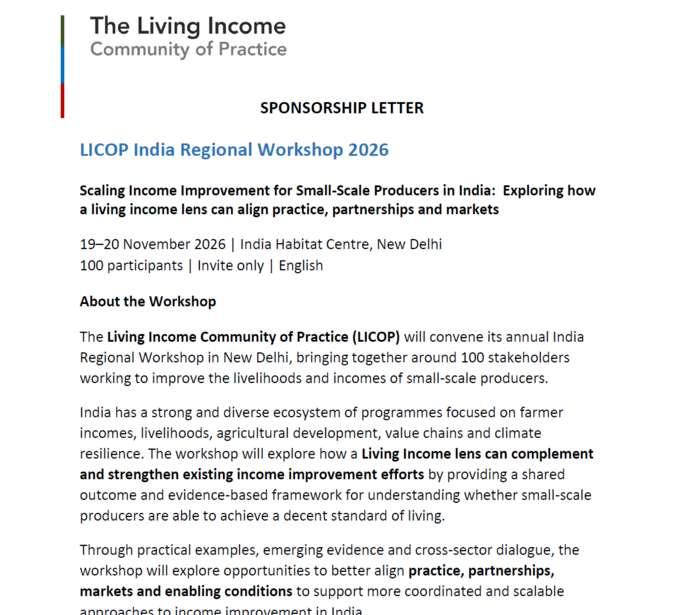
The Living Income Community of Practice (LICOP) will host its annual in-person regional workshop in New Delhi, India, between the 19-20th of November 2026.
India has a strong ecosystem of programmes focused on farmer incomes, livelihoods, value chains, sustainability and climate resilience. Many organisations are implementing income improvement initiatives, however approaches to measuring progress and defining the income needed for a decent standard of living vary, with growing questions around how poverty and income benchmarks can better reflect context-specific characteristics. There is growing interest in moving from isolated projects towards coordinated, scalable solutions that use contextually appropriate references to more accurately capture the realities faced by producers in different regions.
Living income provides a common outcome and evidence-based framework for understanding whether farmers can achieve a decent standard of living. It complements -not replaces- existing income enhancement and rural development initiatives. It enables stakeholders to align measurement, interventions and investment around shared outcomes.
Why India?
India, as one of the world's largest agricultural producers, has a vibrant ecosystem of government programmes, producer organisations, private sector initiatives and civil society organisations already working on farmer incomes. With significant investment already being made to improve farmer incomes, India has an opportunity to explore whether and how a living income approach can add value to existing efforts and support more coordinated, evidence-based action.
Workshop Goal
This workshop will showcase practical experiences from India and beyond, highlight emerging evidence and lessons, and create space for dialogue on how living income approaches can support national priorities related to agricultural development and prosperity. It will also help align ongoing initiatives and foster coordinated action among key stakeholders.
Learning Journeys
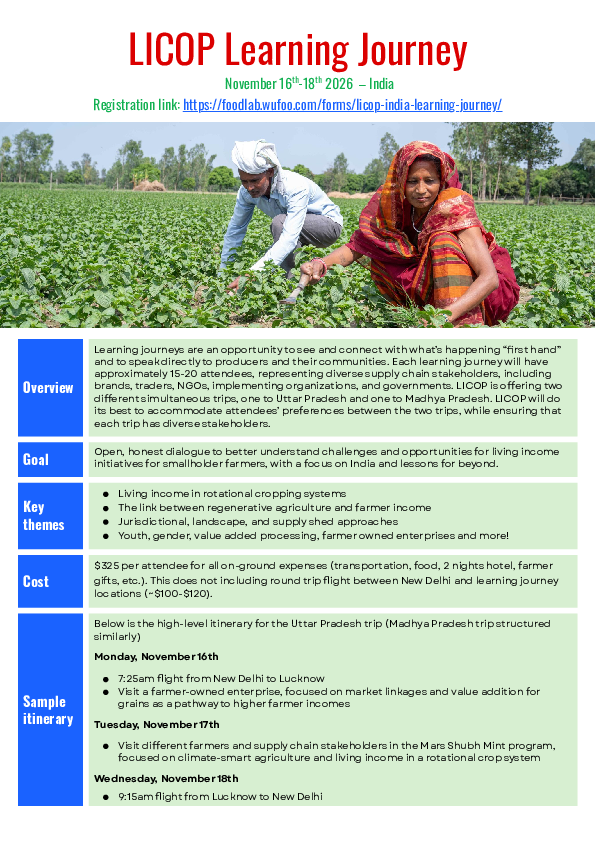
In addition to the workshop, we are offering a unique opportunity to join pre-event learning journeys in Uttar Pradesh and Madhya Pradesh 16-18 November. These learning journeys will provide direct insight into the on-the-ground practices and offer the chance to engage directly with producers and their communities. Please note, each learning journey has a limited space of 15-20 attendees. Registration for the learning journeys is separate from registration for the workshop.
Registration
In-person attendance of the meeting will be limited. We will make a selection of those who have expressed their interest and strive for proper representation of all stakeholders. We will confirm participation by email as soon as possible, but not automatically.
Session 1: Setting the context - Living Income in India
India, one of the world’s largest agricultural producers, has a vibrant ecosystem of government programmes, producer organisations, private sector initiatives and civil society organisations already working to improve farmer incomes. It also has a distinctive context: a vast, price-sensitive domestic market, a government that is a major buyer of agricultural produce, and smallholder households that rely on a diverse mix of crops, livestock, off-farm work and public schemes rather than a single cash crop. With investments already flowing into improving farmer incomes and inclusive value chains, India has an opportunity to explore whether and how a living income approach can add value to existing efforts and support more coordinated, evidence-based action.
This session will set the context for the debate on adopting and adapting the living income concept in India. Leaders will discuss the current agricultural landscape, leading efforts to stabilise and improve farm incomes, and how domestic and international markets shape the business case for action. They will also explore what a decent standard of living means in the Indian context, where subsidies and food distribution schemes play a major role in household budgets. The discussion will lay the foundation for clarifying how a living income lens could add value in India, from household to landscape level, and where the opportunities lie for greater collaboration and impact between actors
Speakers:
Private Sector: Meenal Bahirwani, Mars mint program
Government: Nitish Kumar, SUAti program, GIZ and NABARD
Civil Society: Minhaj Ameen, CEO and Founder, Agroecology
Sector collaboration: Jagjeet Singh Kandal, IDH on cotton and coffee
Moderator: Vidya Rangan, ISEAL
Session 2: Bringing Living Income into Sector Conversations
Drawing on examples from commodity sectors such as tea, coffee, rice and cotton, this practical, interactive session will explore how living income can help sectors move from improving farmer livelihoods to addressing farmer income more systematically. Building on existing efforts around productivity, sustainability, resilience, market access and livelihoods, the discussion will examine what a living income lens adds, how it can help identify income gaps and inform more effective strategies, and where initiatives are already underway globally and in India. It will also consider how living income complements existing efforts on living wages and decent livelihoods, helping companies take a more systematic, evidence-based approach to understanding and addressing income challenges as part of their due diligence.
Through sector examples and interactive discussions, participants will explore where the most promising entry points for living income lie, what initiatives and approaches are already working, and how learning can be shared and scaled. The session will consider the respective roles of different actors, recognising that addressing farmer income challenges requires action beyond individual programmes or companies. It will identify opportunities for greater alignment, effective learning and collective action across sectors and value chains to advance more coordinated and scalable approaches to improving farmer incomes.
Session 3: Connecting climate, nature and producer resilience
Regenerative agriculture and agroecology are increasingly promoted for their climate and nature benefits, but the transition must make economic sense for smallholders. This session opens by clarifying what these approaches mean in the Indian context and how they connect to farmer economics and resilience. Practitioners will then share evidence from the field, including data from a regenerative organic mint programme and examples from sugarcane, cotton and soy. In small table discussions, participants will explore what it takes for farmers to adopt and sustain these practices, who bears the costs and who benefits, and what enabling environment is needed. The session closes with a look at how GIZ and partners plan to take regenerative agriculture to scale in India.
Speakers:
Ishu Pathak, Pavitramenthe
Deepika Agarwal, Pavitramenthe
Isabel Weitzel, GIZ
Moderator: Molly Leavens, Sustainable Food Lab
Session 4: Farmer Owned Enterprises as Drivers of Income and Resilience
For decades, India has been a leader in the movement of farmer-owned distribution, processing, and marketing enterprises. In recent years, the advent of the Farmer Producer Company has fuelled a surge of farmer owned enterprises in the country. With the promise of creating and distributing value to farmers, Farmer Producer Organisations of various sorts are an attractive strategy for achieving decent livelihoods for farming households. But those who have helped establish farmer owned enterprises know that building an effective and profitable farmer enterprise comes with significant challenges.
In this panel, we’ll learn from those who have successfully tackled these challenges, along with others who are facing them now in the early stages of building their business. Bring your questions and thoughts - the session will include ample space for audience Q&A and commentary.
Speakers:
Raj Vable, Young Mountain Tea
Yogesh Dwivedi, Madhya Bharat Consortium of Farmer Producer Companies Limited (MBCFPCL)
Pankaj Nathe, Sahyadri Farms
Moderator: Seth Petches, Sustainable Food Lab
Session 5: Designing Living Income Programmes for Diverse Farming systems
This session will provide insight on how programmes have been designed for diverse farming systems and identify the critical aspects that lead to a sustained effort to support farmers. Examples from leading initiatives on how they are investing with farmers for progress towards living income using a smart mix from procurement levers, technical assistance, and work on efficiency to build value for farmers and strengthen resilience of their supply chains. This will be followed by practical table work.
Speakers:
Cory Gilman, Mars Inc
Joe Boulier, Tanager
Jatin Bavishi, IDH
Moderators: Stephanie Daniels, Sustainable Food Lab and Vaibhav Panpaliya, IDH
Session 6: Bridging the Living Income Gap: Innovative Financing Across Agricultural Value Chains
This session will explore practical financing mechanisms that can help farmers increase and sustain their incomes and move towards a living income and support Farmer Producer Organisations (FPO and agri-enterprises stabilise their revenues and provide support to farmers over the long term.
Speakers from development finance, international rural finance, FPO/value-chain finance, blended finance and impact investment will share real-world models and examples, focusing on how different forms of capital are structured, risks are managed, and finance is linked to value creation and farmer outcomes. The discussion will also identify lessons and opportunities for scaling effective financing models across agricultural value chains.
Speakers:
Anil Kumar S G, Founder and Non-Executive Chairman, Sammunati
Dheeraj Matreja, Associate Director, Rabo Foundation, India
Sarat Kumar, Livelihood Consulting Lead, Vrutti/Catalyst Management Service Moderators: Dr. Deepak Chamola, GIZ and Stephanie Daniels, SFL
Session 7: Greater alignment towards Farmer Income Measurement
Estimating a farmer’s living income gap requires two things: a benchmark for a decent standard of living, and an estimate of what a household earns. This session opens with an overview of living income benchmarking and their unique applications in India, then turns to the practical realities of measuring actual household income. Smallholder incomes come from many sources and are nearly always estimates, so the right approach depends on what you need to know (your use case), your starting data, your capacity, and your budget. Participants will then work at tables through study scenarios to choose fit-for-purpose methods for key income indicators and weigh the trade-offs between rigour, cost, and the decisions the results can support.
Speakers:
Dr. Nidhi Kaiker, Anker Research Institute
Molly Leavens, Sustainable Food Lab
Moderator: Molly Leavens, Sustainable Food Lab
This page will be updated regularly with information on registration, the programme, speakers, learning journeys, and other relevant details.
With support from: